Introduction
This is a work log of my recent research on Hilbert-Huang Transform [HHT], only part of it. Due to the fact that I was lazy about blogging, so the complete work log for HHT is not on the schedule of posting. This post is mainly about the mode mixing problems, including the questions of what it is, how it should be solved, and so forth.
Mode-Mixing Problem
As the essential purpose of Empirical Mode Decomposition [EMD] method is to decompose the signal to many IMFs with different range of frequency. From low frequency to high frequency, we can designate them as different mode. So if the situation occurs, that the frequencies in different range mixed in one signal or in one IMF, this is called the mode mixing problem. In this case we need a process to pick the specific mode or say to separate the different mode. It should be mentioned that the basic EMD method fails in this problem for some reason which I’m not gonna describe here.
Ensemble Empirical Method Decomposition [EEMD]
In 2009, Huang propose a method to solve the mode-mixing problem by adding white noise to the target signal. With the relatively high frequency white noise added, the proposed EEMD is developed as follows¹:
- add a white noise series to the targeted data;
- decompose the data with added white noise into IMFs;
- repeat step 1 and step 2 again and again, but with different white noise series each time; and
- obtain the (ensemble) means of corresponding IMFs of the decompositions as the final result.
well, it should be noticed that you add white noise once, you do the EMD then, you only get a series of IMFs with white noise you added. As step 3 and step 4 proposed, we need to repeat process of adding white noise and doing EMD, we obtain many different series of IMFs then, the amount of series depends on the ensemble number you set. Ensemble number means how many times you added the noise to the data. When you calculating the means of corresponding IMFs, the lager ensemble number you set, you can wipe the noise from the signal completely. As showed in these figures, with more times I added white noise, the signal here is outstanding from the white noise. In this case, the expected signal appears. Nevertheless, in the process of EEMD, the white noise or say noise, are not possible to exclude completely. So in practical situation, we concerned about the signal-noise ratio [SNR].
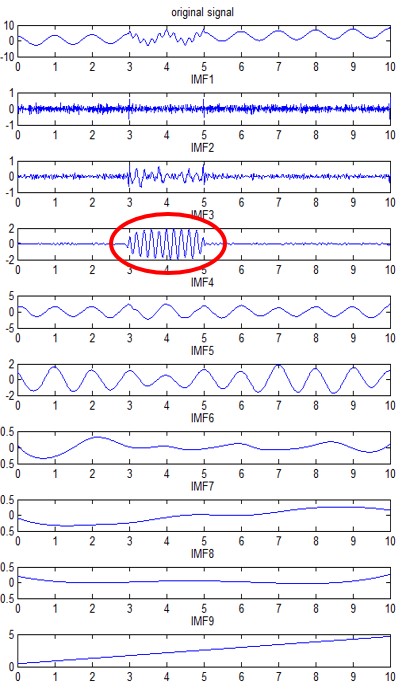
As you see in this figure, with the ensemble number up to one thousand, the SNR is good enough for the physical analyses. the high frequency signal constrain in the middle of the whole interval, which is exactly the signal I’ve constructed. So in the process of decomposing the the signal, it’s important to distinguish the signal with physical meaning from the noise. So the question here is Which components of a signal are noise?
Well, as the lower amplitude of the noise you added, the more significant the signal was. FYI the proper low amplitude of noise can raise the SNR. By setting different amplitude (different means statistical expectation different, due to that the white noise added by random numbers varies by an expectation, amplitude of noise are different in each noise-added process of course.) the specific components of the signal had distinct decrease for same ensemble number. Bang! That’s noise for sure! Because, obviously the signal only agree to the mean value when the ensemble number increase.
Does it mean you can add unlimited low noise to the signal to obtain best SNR? Absolutely not! The fact is that if the added noise amplitude is too small, it may not introduce the change of extrema the EMD relies on somehow¹. So here is the STRATEGY of adding white noise: add the amplitude 0.2 times the standard deviation of the original signal, and set the ensemble numbers large enough for acceptable SNR, which I recommend 1000 times at least.
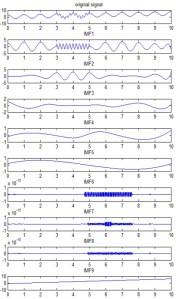
Last but not least, I post two decomposition result of EMD and EEMD for comparison as follows:
left:EMD mode-mixing result; right:EEMD mode-mixing (solved) result
Reference
- Ensemble empirical mode decomposition: a noise-assisted data analysis method. Advances in adaptive data analysis, 1(01), 1-41.
 Blackhole